
Reviews
User Score
Rate This
Descriptions:
Sacred Blood: Forged in the Four Corners
When Sacred Blood first came together, there wasn’t much of a metal scene in Gallup.
At least not the kind founder Rippy had seen while stationed in Southern California during his time in the
Marine Corps.
Night after night, he was attending shows at places like the Whisky a Go Go, The Roxy, The Glass House,
and countless clubs throughout the Los Angeles area. Heavy music was everywhere. Bands were constantly
playing. New groups were constantly emerging.
Then he came home.
And suddenly everything felt quiet.
Instead of complaining about it, he started doing something about it.
After discovering bands like Ethnic Degeneration, Mole Spore, Dying Tribe, and others throughout the Four
Corners region, Rippy began organizing shows and helping connect musicians who otherwise might never
have crossed paths. What started as promoting local metal eventually evolved into something bigger.
A band of his own.
Sacred Blood.
Unlike many groups that spend months debating names, logos, and concepts, Sacred Blood grew naturally.
Songs came first. Everything else followed. The band’s name was inspired by a phrase Rippy heard while
serving overseas, and even the original logo carries a personal touch—the handprint at its center belongs
to his daughter when she was just a toddler.
The music itself was built the same way.
Fast.
Instinctive.
Honest.
Many Sacred Blood songs were written in a matter of minutes. Rather than overthinking arrangements, the
band trusted its instincts. If a riff worked, it stayed. If a song felt right, they ran with it.
That approach produced some of the band’s most memorable material.
1One song, Die In My Sleep, was inspired by a near tragedy while driving home from a show. After a band
member fell asleep behind the wheel, another woke just in time to grab the steering wheel and prevent a
devastating accident. By the time everyone got home safely, the band was already writing a song about the
experience.
That’s how Sacred Blood operated.
Life happened.
Then it became music.
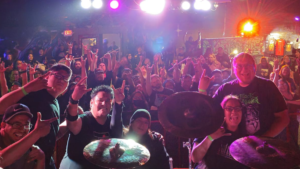
Throughout the 2000s, the band rarely stayed still. Recording sessions, weekend shows, long drives, and
festival appearances became a way of life. At their busiest, Sacred Blood estimates they played close to one
hundred shows a year, sharing stages with local favorites, national acts, and anyone willing to crank up an
amplifier.
Like many bands, time eventually pulled members in different directions.
Careers.
Families.
New responsibilities.
The nonstop schedule slowed.
The shows became less frequent.
But the songs never disappeared.
Years later, old friendships, old riffs, and old memories found their way back into rehearsal rooms. What
began as casual conversations eventually became something more.
A reunion.
A fresh start.
A reminder that some bands never really break up.
They just get quieter for a while.
Today, Sacred Blood continues doing what it has always done best: turning real-life experiences into heavy
music and proving that the Four Corners metal scene is still very much alive.
And somewhere along the way, Rippy’s daughter went on to form her own band, The Sillyettes, carrying
that same DIY spirit into a new generation of musicians.
2