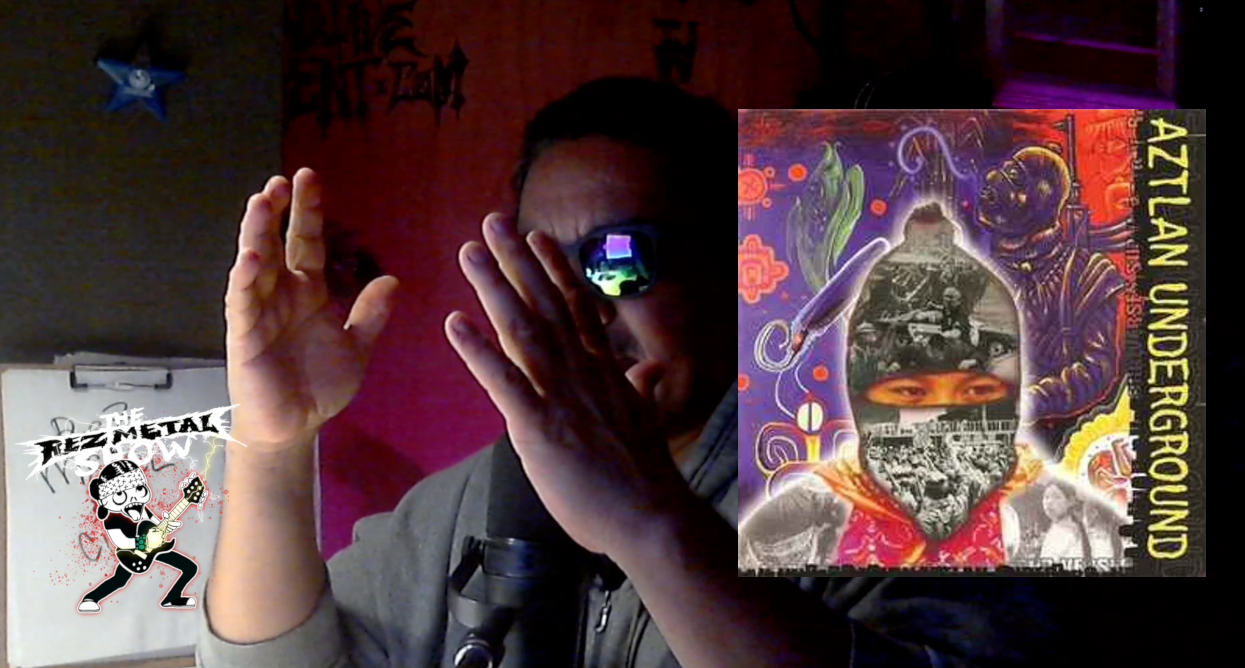
Aztlan Underground

Before Indigenous Heavy Music Had a Name
Long before Native rap-rock, Indigenous metal, and politically charged heavy music became common, Aztlan Underground was already kicking down doors.
The first time I heard Aztlan Underground, it wasn’t through the internet.
It wasn’t through Spotify.
It wasn’t through YouTube.
It came from a cassette tape.
Back in 1999, while stationed at Fort Lewis, Washington, I found myself digging through a box of demos and recordings belonging to a pseudo famous underground Native rapper I was kicking back with. She asked me to help her look through tape submission she would get. Buried among the tapes was something called Aztlan Underground.
I popped it into a player.
Within minutes, I was hooked.
The sound didn’t fit into any category I knew.
Heavy guitars collided with hip-hop rhythms. Spoken-word passages sat next to tribal percussion. Indigenous themes mixed with punk attitude and rap energy. It felt familiar and completely alien at the same time.
Most importantly, it felt powerful.
At the time, there wasn’t much like it.
Today, it’s easy to find bands blending genres. Every streaming service is filled with artists combining styles and influences. Back then, Aztlan Underground sounded like it came from another planet.
Formed in East Los Angeles in 1989, the group spent decades creating music that ignored boundaries. They weren’t interested in fitting into metal, punk, hip-hop, or alternative music. They simply took what worked and built something of their own.
That approach helped make them one of the most influential Indigenous heavy acts of their generation.
Yet their name rarely comes up in conversations about influence.
Ask musicians about Indigenous heavy music and many will point to newer artists. Ask them about rap-rock and they’ll mention mainstream bands that came years later. But Aztlan Underground was already exploring those sounds before many people knew what to call them.
What made the band stand out wasn’t just their message.
It was the presentation.
The percussion.
The atmosphere.
The intensity.
Seeing them live was an entirely different experience than hearing them on a recording. Traditional instruments appeared alongside crushing rhythms and aggressive guitars. The result felt less like a concert and more like an event.
The band wasn’t interested in staying inside one lane.
Neither was the audience.
Fans from punk, metal, hip-hop, alternative, and Indigenous music circles all found something to connect with.
That’s part of what makes Aztlan Underground important today.
They proved Indigenous music didn’t have to fit into a single box.
It didn’t have to sound a certain way.
It didn’t have to come from a specific place.
Whether it came from a reservation, a city block, or somewhere in between, the music was still valid.
For Rez Metal Magazine, Aztlan Underground represents something bigger than a catalog of albums or a list of accomplishments.
They represent possibility.
They showed younger generations that heavy music could carry Indigenous perspectives without sacrificing intensity.
They showed artists that experimentation wasn’t something to fear.
Most of all, they proved that Indigenous musicians could build their own lane instead of waiting for permission to enter someone else’s.
More than three decades after their formation, that’s still a lesson worth remembering.
The sound may have changed.
The scene may have changed.
But the impact remains.
Long before Indigenous heavy music became a movement, Aztlan Underground was already there, making noise.